
Semax Dosage Chart for a 10 mg Vial
This Semax dosage chart explains how a 10 mg vial can be calculated for intranasal research with a verified 0.10 mL metered actuator. Published human Semax studies primarily used intranasal drops or measured intranasal solution. A measured 5 mL final volume provides 200 mcg per spray, while a measured 10 mL final volume provides 100 mcg per spray.
- Primary human research route: Intranasal drops or measured intranasal solution.
- 5 mL final volume: 2 mg/mL, 200 mcg per verified 0.10 mL spray, and 50 nominal sprays.
- 10 mL final volume: 1 mg/mL, 100 mcg per verified 0.10 mL spray, and 100 nominal sprays.
- Device check: Confirm the pump output and follow its priming instructions before using the calculation.
- Research context: Published amounts varied by study population, formulation, and research objective.
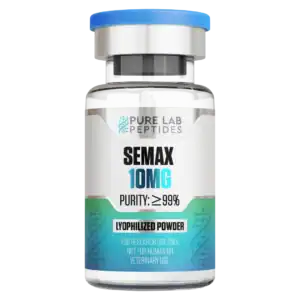
Semax is a synthetic heptapeptide based on the ACTH(4-10) sequence. Human research has evaluated intranasal Semax in healthy volunteers and in condition-specific neurological studies[1][2][3]. The calculations below use the entire 10 mg vial and keep published study protocols separate from worked preparation examples.
Research context: For evidence on mechanisms, human and preclinical research, limitations, and safety, read Semax Peptide: Benefits, Uses, Side Effects, Dosage, and Research.
Dosing & Reconstitution Guide
Semax 10 mg intranasal research calculations for 5 mL and 10 mL final volumes
Semax 10 mg Nasal Spray Calculations
Both options begin with 3.0 mL in the peptide vial. Transfer the complete solution, then add enough vehicle to reach the measured final volume.
| Measured Final Volume | Vehicle Added After Transfer | Final Concentration | Per Verified 0.10 mL Spray |
|---|---|---|---|
| 5.0 mL | About 2.0 mL | 2,000 mcg/mL | 200 mcg 50 nominal sprays |
| 10.0 mL | About 7.0 mL | 1,000 mcg/mL | 100 mcg 100 nominal sprays |
Calculation basis: Each row uses the full 10 mg vial and a pump verified to release 0.10 mL per complete actuation. Nominal spray counts are calculated before priming and normal residual hold-up.
How to Prepare the 5 mL or 10 mL Research Bottle
- Confirm the 10 mg vial, selected sterile research vehicle, actuator bottle capacity, and documented pump output.
- Add 3.0 mL of compatible sterile vehicle to the vial with aseptic transfer technique.
- Gently swirl until the contents are dissolved. Do not shake.
- Transfer the complete 3.0 mL solution into a sterile 5 mL or 10 mL nasal actuator bottle.
- Add enough vehicle to reach a measured final volume of exactly 5.0 mL or 10.0 mL. The theoretical additions are approximately 2.0 mL and 7.0 mL.
- Secure the pump and label the bottle with the peptide amount, final volume, concentration, pump output, and preparation date.
- Prime the pump according to the actuator instructions and record the priming sprays in the research log.
Vehicle context: The worked example can use sterile 0.9% saline as a research vehicle. Kaplan and colleagues reported physiological solution in one human experiment. The registered 0.1% Semax product used purified water with methylparaben, so the saline example is not the same as the registered multidose formulation[1][4].
Research Amount to Spray Equivalents
| Research Amount | 5 mL Option 200 mcg per Spray |
10 mL Option 100 mcg per Spray |
|---|---|---|
| 200 mcg | 1 spray | 2 sprays |
| 300 mcg | 1.5 theoretical sprays | 3 sprays |
| 400 mcg | 2 sprays | 4 sprays |
| 500 mcg | 2.5 theoretical sprays | 5 sprays |
These rows are concentration conversions. They do not turn one study amount into a universal schedule. Fractional results are mathematical only because a metered pump cannot deliver half of a full actuation.
Published Human Intranasal Semax Research
Human Semax research has primarily used the intranasal route. The studies below show the reported amount, formulation, and research setting so visitors can compare the literature without treating different protocols as interchangeable.
| Source | Research Context | Published Intranasal Amount and Formulation |
|---|---|---|
| Kaplan et al., 1996[1] | Healthy volunteers in operator and EEG experiments | Experiments included 0.210 mg and 1 mg exposures. The operator experiment reported 1 mg in 0.4 mL physiological solution. |
| Lebedeva et al., 2018[2] | Healthy volunteer fMRI study | One 1.2 mg exposure using a 1% solution, with 60 microliters placed into each nostril. |
| Gusev et al., 2018[3] | Condition-specific post-stroke research | 6,000 mcg per day for 10 days, followed by a second 10-day course after a 20-day interval. |
| Official 0.1% Semax instructions[4] | Registered intranasal drop formulation | 1 mg/mL in purified water with methylparaben. Each 0.05 mL drop contained 50 mcg. |
The 10 mL calculation above produces 1 mg/mL, which matches the concentration of the registered 0.1% drop formulation. The device and formulation are still different, so concentration equivalence does not establish identical delivery, stability, or dosing.
Nasal Spray Actuator Math
A 0.10 mL actuator is a common nasal pump configuration, but pump output is not universal. Pharmaceutical literature reports pump volumes from approximately 0.025 mL to 0.20 mL per spray[5]. Use the manufacturer specification or a validated measurement for the exact device.
Core Formula
mcg per spray = (10,000 mcg / final volume in mL) x verified mL per spray
nominal sprays = final volume in mL / verified mL per spray
| Verified Actuator Output | 5 mL Option 2,000 mcg/mL |
10 mL Option 1,000 mcg/mL |
|---|---|---|
| 0.05 mL | 100 mcg | 50 mcg |
| 0.10 mL | 200 mcg | 100 mcg |
| 0.13 mL | 260 mcg | 130 mcg |
Actuator Checks Before Recording a Result
- Confirm the stated volume per full actuation for the specific pump.
- Follow the documented priming and repriming procedure.
- Record residual volume and tail-off near bottle exhaustion when estimating usable sprays.
- Keep pump orientation and actuation stroke consistent during the research procedure.
FDA nasal spray guidance treats pump delivery, priming, dose uniformity, and bottle exhaustion as product performance variables[6].
Supplies Needed
Use one complete set of measured and sterile research supplies for each prepared Semax 10 mg nasal bottle.
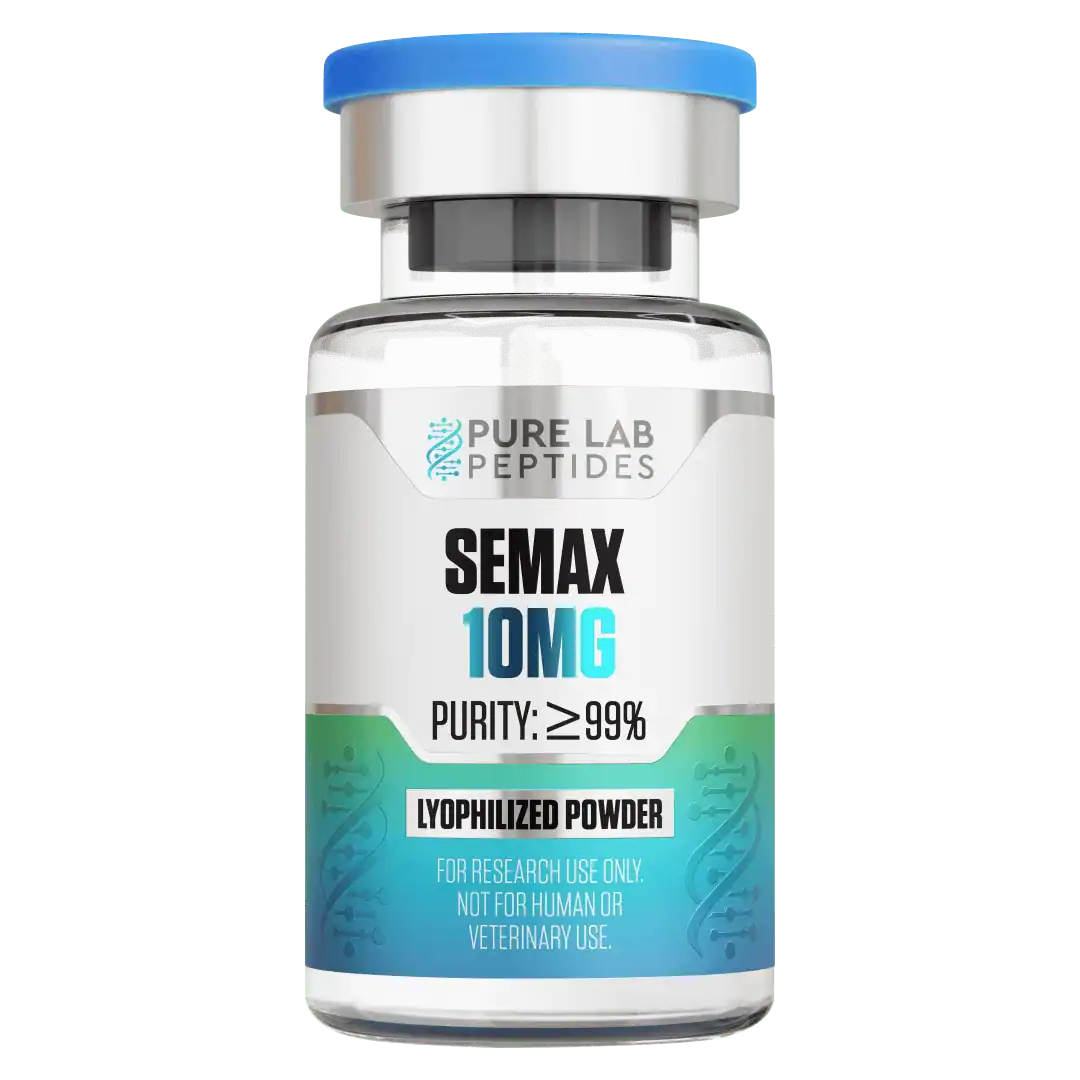
- Semax 10 mg research vial: One vial per prepared bottle. The product gallery below links to the existing Semax 10 mg supplier page.
- Sterile research vehicle: Single-use sterile 0.9% sodium chloride for the worked saline example, or another validated sterile nasal research vehicle.
- Sterile nasal actuator bottle: One 5 mL or 10 mL bottle intended for single-user research.
- Metered pump: A compatible actuator documented or verified at 0.10 mL per complete spray.
- Calibrated transfer tools: Sterile syringes or pipettes that can measure the initial 3.0 mL and the exact 5.0 mL or 10.0 mL final volume.
- Sterile transfer needle: Required when the peptide vial uses a rubber septum.
- Clean handling supplies: Alcohol preparation pads, clean gloves, and a disinfected work surface.
- Label and research log: Record the peptide amount, final volume, concentration, pump output, preparation date, priming sprays, and actuation count.
- Storage materials: Light-protective refrigerated storage appropriate to the validated formulation.
- Sharps container: Use when transfer needles are part of the preparation workflow.
Research Protocol Overview
Quick reference for the intranasal Semax 10 mg calculation.
- Human research route: Intranasal drops or solution.
- Peptide amount: 10,000 mcg total in the vial.
- 5 mL option: 2,000 mcg/mL and 200 mcg per verified 0.10 mL spray.
- 10 mL option: 1,000 mcg/mL and 100 mcg per verified 0.10 mL spray.
- Final-volume rule: Bring the transferred solution to an exact measured final volume.
Research Amount Calculator
Spray equivalents for a verified 0.10 mL actuator.
- 200 mcg: 1 spray at 5 mL or 2 sprays at 10 mL.
- 300 mcg: 1.5 theoretical sprays at 5 mL or 3 sprays at 10 mL.
- 400 mcg: 2 sprays at 5 mL or 4 sprays at 10 mL.
- 500 mcg: 2.5 theoretical sprays at 5 mL or 5 sprays at 10 mL.
- Interpretation: These are mathematical equivalents. Fractional values cannot be delivered as partial pump strokes. Match any research amount to its original study context.
Storage Instructions
Storage depends on the complete formulation, container, and handling method.
- Registered 0.1% product: Protected from light, stored at no more than 10 degrees C, and not frozen[4].
- Custom research preparation: Use formulation-specific stability and microbiological controls.
- Labeling: Record preparation date, final volume, concentration, vehicle, and storage conditions.
- Handling: Keep the cap secured and minimize unnecessary warming and light exposure.
Important Notes
Small measurement and device details can materially change the amount delivered per spray.
- Use a measured final volume, not the bottle capacity mark alone.
- Verify that the actuator releases 0.10 mL per full stroke before applying the main table.
- Prime and reprime exactly as specified for the pump, then record those actuations.
- Keep the bottle upright and use a complete, consistent stroke for each recorded spray.
- Treat the theoretical 50 or 100 sprays as nominal counts because priming and residual hold-up consume part of the volume.
- Use a validated laboratory handling and stability plan for any custom multidose preparation.
How Intranasal Semax Research Works
Semax is a synthetic heptapeptide based on the ACTH(4-10) sequence and was developed without the hormonal activity of full-length ACTH. Published research has examined neurotrophic signaling, attention, memory, and condition-specific neurological outcomes[1][3][7]. Intranasal delivery places a measured solution on the nasal mucosa, which is the route used in the human studies summarized on this page.
The calculation is concentration based. Dividing 10,000 mcg by the measured final volume gives mcg per mL. Multiplying that concentration by the verified pump output gives mcg per spray.
Human Research Findings and Observations
Semax findings should be read together with the population, amount, formulation, and study design.
- Healthy-volunteer studies reported changes in attention, operator performance, EEG measures, or functional connectivity after intranasal exposure[1][2].
- Condition-specific studies evaluated neurological recovery and other outcomes using protocols that were substantially different from healthy-volunteer experiments[3].
- The official 0.1% drop instructions report possible mild nasal mucosal irritation with prolonged use[4].
- Pump output, formulation, nasal condition, and administration technique can affect the delivered amount and deposition pattern[5][6].
Research Controls That Affect Nasal Delivery
Consistent technique improves the value of recorded research observations.
- Pump specification: Record the stated or measured mL per actuation.
- Priming status: Document first use, repriming, and any missed sprays.
- Actuation technique: Keep bottle orientation, stroke length, and stroke force consistent.
- Nasal condition: Record congestion, irritation, or other conditions that could affect deposition.
- Formulation details: Record the vehicle, final volume, concentration, container, and storage conditions.
- Actuation count: Track sprays from priming through final use to identify tail-off and residual volume.
Nasal Actuator Technique
Use a standardized device procedure so the recorded amount remains consistent across research observations.
- Inspect the labeled concentration and confirm the actuator output before use.
- Prime or reprime the pump according to the manufacturer instructions.
- Keep the bottle in the specified orientation and use one complete, smooth stroke.
- Record each actuation immediately, including priming sprays.
- Wipe the nozzle with a clean material appropriate for the device and replace the cap.
- Return the bottle to its documented storage condition after the research procedure.
Important Note
This content is for educational purposes only and is not medical advice.
References
-
Kaplan et al. (1996)
Synthetic ACTH analogue Semax displays nootropic-like activity in humans. Reports intranasal healthy-volunteer experiments, including physiological solution context. -
Lebedeva et al. (2018)
Effects of Semax on the default mode network of the brain. Healthy-volunteer fMRI study using a single 1.2 mg intranasal exposure. -
Gusev et al. (2018)
Efficacy of Semax in patients at different stages of ischemic stroke. Reports 6,000 mcg per day in two 10-day courses separated by 20 days. -
Official Semax 0.1% Instructions
Registered intranasal drop formulation, composition, amount per drop, administration details, and storage conditions. -
Trows et al. (2014)
Analytical challenges and regulatory requirements for nasal drug products in Europe and the United States. Reviews pump output and device variables. -
U.S. Food and Drug Administration
Nasal Spray and Inhalation Solution, Suspension, and Spray Drug Products. CMC guidance covering pump delivery, priming, dose uniformity, and product performance. -
Deigin et al. (2022)
Development of peptide biopharmaceuticals in Russia. Academic review of Semax development, formulation, and research context.
Related research, protocols, and guides
Explore the available research context, protocol variants or comparisons, and practical guides. When vial-size variants exist, they remain separate because vial strength, concentration, and syringe-unit calculations can differ. Related compounds and blends are comparisons only, not interchangeable.
Research overview
Other vial-size protocols
Related protocols and comparisons